Roth IRA Explained: Why Starting Young Can Be So Powerful
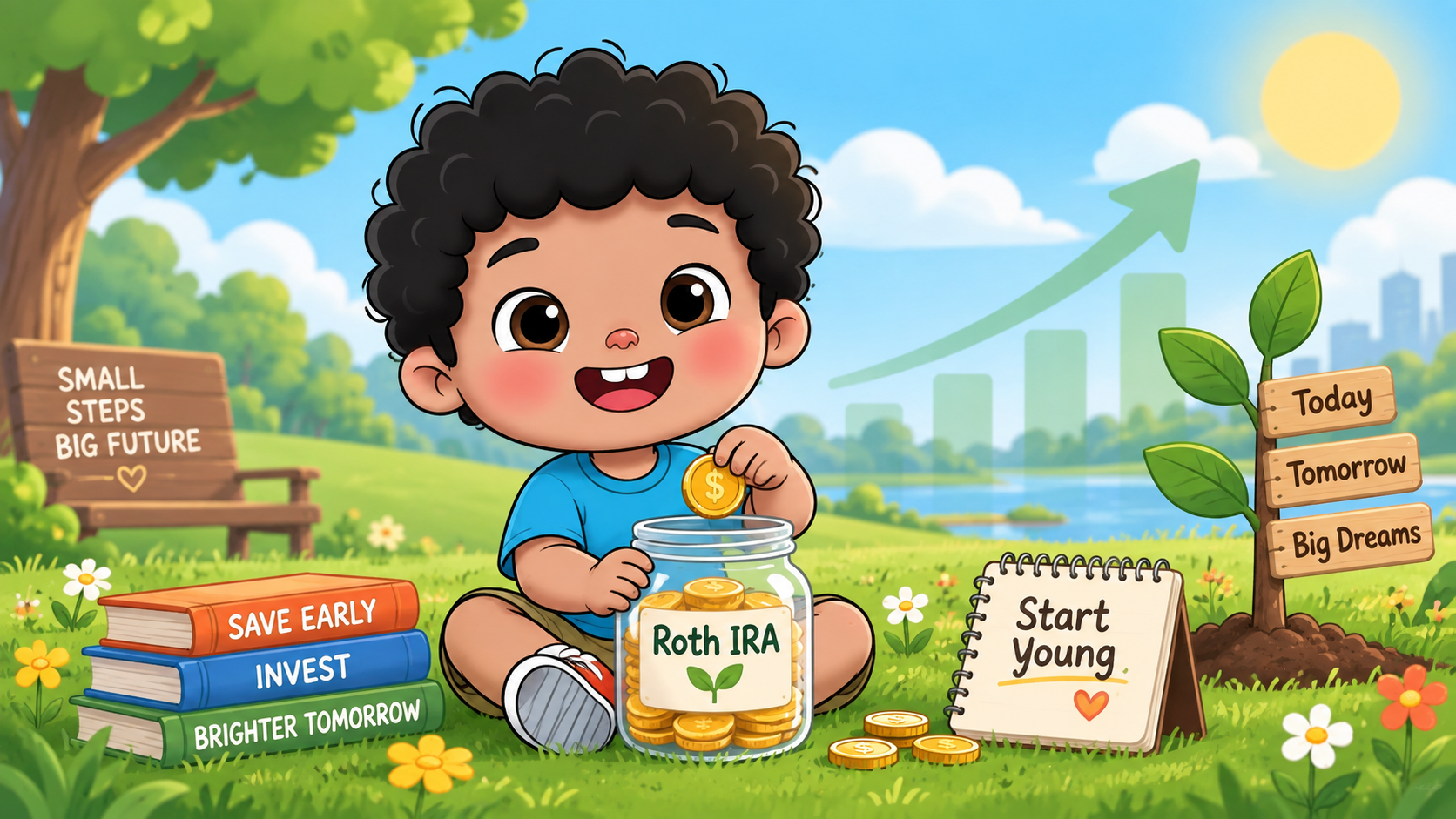
A Roth IRA is usually described as a retirement account.
That description is correct, but it can make people think they should wait until they are older before paying attention to it.
The opposite can be true.
A Roth IRA can be useful from a surprisingly young age, and for many young investors it may be more attractive than taking a Traditional IRA deduction today.
To understand why, you need three ideas:
Tax Now
Tax Later
Tax Never
And one more thing that matters more than all of them:
time.
What Is a Roth IRA?
A Roth IRA is a tax-advantaged retirement account.
You contribute money that has already been taxed, and you generally do not receive an income-tax deduction for contributing.
In exchange, investments inside the account can grow without annual taxes on capital gains, dividends, or interest inside the account.
And if a withdrawal qualifies under the Roth IRA rules, it can come out free of federal income tax.
That is the basic trade:
Pay tax today. Potentially avoid federal income tax on qualified withdrawals later.
What Makes a Distribution Qualified?
This is one of the most misunderstood parts of a Roth IRA.
In general, earnings can be distributed tax-free as part of a qualified distribution when the applicable five-year requirement has been met and a qualifying condition also applies, such as reaching age 59½.
Other qualifying circumstances can include death, disability, and certain first-time homebuyer distributions, subject to applicable limits and rules.
The important point is that Roth tax treatment depends on more than simply opening the account.
The rules matter.
Starting the Five-Year Clock Early
The five-tax-year period generally begins with the tax year for which your first Roth IRA contribution is made.
That creates another reason to consider opening a Roth early when you are eligible.
Even a relatively small first contribution can begin that five-year period.
Start the clock early.
You Can Take Regular Contributions Back Out
Another feature surprises many people.
Regular Roth IRA contributions are generally treated as coming out before earnings under the Roth ordering rules.
Because those regular contributions were already made with after-tax money, they can generally be withdrawn without additional federal income tax or the 10% early-distribution penalty.
That creates more flexibility than many young investors expect.
The earnings are different.
Taking earnings out before satisfying the applicable rules can create income tax and potentially an additional penalty.
This does not mean a Roth IRA should be treated like a checking account or emergency fund.
Every dollar permanently removed is a dollar that stops compounding inside the Roth.
A Roth IRA Is an Account, Not an Investment
This distinction matters more than almost anything else in this article.
A Roth IRA is not a stock.
It is not an ETF.
It is not a mutual fund.
It is not an investment strategy.
It is a container.
A Roth IRA is an account / tax structure. The investment is whatever you choose to hold inside it. Opening a Roth IRA and transferring cash into it does NOT automatically mean the money has been invested.
Depending on the brokerage and account permissions, the account may be able to hold investments such as:
- Stocks
- ETFs
- Mutual funds
- Bonds
- Cash
- Money market funds
- Certain permitted options positions
Cash sitting inside a Roth can still just be cash.
You still have to decide what assets to own.
The Roth gives you the tax structure. Your investments determine the return.
You Can Start Much Younger Than Most People Realize
There is no general rule saying you must be 18, 21, or 30 years old before contributing to a Roth IRA.
What matters is whether you have eligible compensation and otherwise qualify to contribute.
No general minimum age. There is no rule requiring you to be 18, 21, or any other specific age to contribute to a Roth IRA — what matters is eligible compensation. A minor can generally use a custodial Roth IRA, with an adult acting as custodian until control transfers under applicable state law and the custodian's rules. Either way, your contribution can never exceed your eligible compensation for the year.
That means a teenager with legitimate earned income may potentially begin years before starting a traditional career.
Suppose a teenager earns:
Earned income: $3,000
Potential Roth contribution: Up to $3,000
That does not mean they can automatically contribute the full annual IRA maximum.
Their eligible contribution is generally limited by their compensation.
So if they earn $3,000, they may potentially contribute up to $3,000, assuming the other requirements are satisfied.
The point is not to contribute a huge amount immediately.
The point is:
Start the clock early.
Why Starting Young Matters So Much
Imagine one investor starts at age 16.
Another starts at age 35.
The first investor has almost two additional decades for the money to potentially compound.
A young investor owns something an older investor cannot buy at any price:
time.
Even relatively small contributions can become meaningful when they have 40, 50, or more years to grow.
And inside a Roth IRA, qualified future distributions can receive extremely favorable federal tax treatment.
Time is an asset.
Contribution Limits for 2026
2026 IRA Limit: $7,500
Age 50+: $8,600 total (includes a $1,100 catch-up)
For 2026, the general IRA contribution limit is $7,500. For people age 50 or older, the catch-up amount is $1,100, bringing the total to $8,600.
There are several important rules to remember.
- The limit is combined. The annual IRA contribution limit generally applies across Traditional and Roth IRAs together. It is not $7,500 into a Traditional IRA plus another $7,500 into a Roth IRA.
- Compensation can limit the contribution. If you earn only $4,000 of qualifying compensation, you generally cannot contribute $7,500 simply because that is the annual maximum.
- Income limits apply to direct Roth contributions. For 2026, direct Roth IRA contribution eligibility phases out at higher income levels. For single and head-of-household filers, the phase-out range is $153,000 to $168,000 of modified adjusted gross income. For married couples filing jointly, the range is $242,000 to $252,000.
Higher-income taxpayers may sometimes consider a backdoor Roth strategy, but that comes with separate tax rules and potential complications.
You also generally have until the federal tax-filing deadline for the following year to make an IRA contribution for the prior tax year.
Always verify current IRS rules because contribution limits and phase-out ranges change over time.
Why Choose Roth Instead of Traditional?
Both accounts provide tax advantages.
The difference is mainly when you receive the tax advantage.
Traditional IRA: Tax Later
An eligible Traditional IRA contribution may be deductible from taxable income.
Suppose you contribute $7,500. If you qualify for the full deduction, your taxable income may be reduced by that amount.
That can create an immediate tax benefit.
But it does not mean the government permanently made the $7,500 tax-free.
You generally postponed the tax.
The money grows tax-deferred inside the account.
Later, taxable distributions generally include deductible contributions and earnings as ordinary income.
The simplified model is:
Deduction today → tax-deferred growth → taxes later
Traditional IRA is therefore a Tax Later account.
Traditional IRAs are also eventually subject to required minimum distribution rules at the applicable starting age under current law.
That means the account owner may eventually be required to begin taking distributions even if the money is not immediately needed.
Roth IRA: Tax Now, Then Potentially Never Again
Roth reverses the timing.
There is generally no deduction today.
But qualified withdrawals, including qualifying investment growth, can eventually come out free of federal income tax.
And unlike a Traditional IRA, a Roth IRA does not currently require lifetime RMDs for the original owner.
That means if the owner does not need the money, the account may potentially continue compounding.
Why give up today's deduction?
Because you may be surrendering a tax benefit on a relatively small amount of money today in exchange for sheltering a much larger amount later.
Suppose you contribute $7,500. Imagine that over many decades it grows to $25,000, then $50,000, then $100,000.
Those numbers are only hypothetical. Returns are never guaranteed.
But the tax concept is what matters.
With a Traditional IRA, you may receive a deduction on the seed, but taxable withdrawals may include the harvest. With a Roth IRA, you pay tax on the seed, while a qualified harvest can be tax-free.
So the real question is not "How much tax can I save this year?"
It is:
Which dollars would I rather protect from future taxation?
TRADITIONAL IRA
- Tax benefit: potentially today
- Contribution: may be deductible
- Growth: tax-deferred
- Withdrawal: taxable amounts generally taxed as ordinary income
- RMD (original owner): eventually required under applicable rules
- Core idea: Tax Later
ROTH IRA
- Tax benefit: later
- Contribution deduction: generally none
- Growth: tax-advantaged
- Qualified withdrawals: federally tax-free
- Lifetime RMD (original owner): none under current law
- Core idea: Tax Now → potentially never again
The Three Tax Buckets
One simple way to understand retirement and investment accounts is through three tax buckets.
TAX NOW — Example: taxable brokerage account. Concept: earn money → pay income tax → invest what remains. Even after paying income tax initially, dividends, interest, and realized capital gains may create additional taxes later.
TAX LATER — Example: Traditional IRA. Concept: potential deduction today → tax-deferred growth → taxable distributions later. You did not necessarily eliminate the tax — you moved it into the future.
TAX NEVER (AGAIN) — Example: Roth IRA. Concept: tax paid before contribution → qualified future withdrawals can potentially be federally tax-free. Roth contributions were already taxed before going into the account, so the more precise description is Tax Now → then potentially never again.
Once the money is properly inside the Roth and the applicable qualified-distribution rules are satisfied, qualifying investment growth can potentially escape future federal income taxation when distributed.
That is what makes Roth so interesting.
Why Roth Can Be Especially Attractive When You Are Young
Suppose you are in a hypothetical 12% marginal federal income-tax bracket.
Traditional IRA contribution: $7,500
Hypothetical marginal federal tax rate: 12%
Approximate immediate tax benefit: $7,500 × 12% = $900
That is real money.
But now ask another question.
What if that $7,500 eventually becomes $100,000?
Would you rather receive a tax break on $7,500 today? Or would you rather give decades of potential growth the opportunity to live inside a Roth environment where qualified withdrawals can be tax-free?
For many young investors, that trade is compelling.
A young person may currently be in one of the lowest tax brackets of their working life.
As income rises later, their marginal tax rate may rise too.
Giving up a deduction at a relatively low tax rate can therefore be much easier to justify than giving up a deduction when the current tax rate is much higher.
That is the argument for Roth-first when you are young.
Not because Traditional IRA is bad.
But because:
Low current tax rate + long investment horizon + decades of compounding + qualified tax-free withdrawals
can be a very powerful combination.
The biggest tax break is not always the one you can see on this year's tax return.
Traditional Can Still Be Better for Some People
Roth is not automatically right for everyone.
Someone who is currently in a high marginal tax bracket and expects to be in a significantly lower bracket during retirement may get more value from a Traditional deduction today. Traditional IRA deductibility can also depend on workplace retirement-plan coverage, filing status, and income.
So the correct conclusion is not "Roth is always better."
It is: the younger you are and the lower your current tax rate, the stronger the argument for paying tax now and allowing future growth to live inside the Roth structure.
If You Own a Business, Your Child May Be Able to Start Even Earlier
For parents who own businesses, there is another opportunity worth understanding.
If your child genuinely works for your business, the business may pay reasonable compensation for the actual work performed.
Those wages are earned income.
Earned income may create Roth IRA contribution capacity for the child.
That can create a powerful progression:
Real work → reasonable wages → earned income → Roth IRA eligibility → long-term compounding
There can also be a business deduction on the other side.
Legitimate employee compensation is generally a business expense.
So properly paying a child for genuine services may reduce the business's taxable profit while simultaneously creating earned income for the child.
This only works when the child performs legitimate work and receives reasonable compensation.
But every part of the arrangement has to be legitimate.
The Work Must Actually Happen
This is not a mechanism for simply handing a child $7,500 and calling it salary.
The child must perform real services for the business.
The pay should be reasonable for the work performed.
The business should maintain proper documentation, including:
- Work performed
- Hours worked
- Rate of pay
- Payroll records
- Required tax forms
- Evidence that the work was actually completed
Appropriate work depends on the child's age and abilities.
Examples might include legitimate administrative tasks, organizing materials, basic content work, inventory-related tasks, cleaning a work area, photography or modeling when appropriate, or other real business services.
The key word is:
real.
Treat the child like an actual employee because that is what the tax treatment depends on.
The Business May Get a Deduction While the Child May Owe Little Federal Income Tax
This is where the strategy becomes especially interesting.
Business: pays legitimate wages → may deduct reasonable compensation as a business expense.
Child: receives earned income → may owe little or no federal income tax depending on income and circumstances → receives Roth contribution capacity.
Legitimate wages can generally be deductible to the business.
Meanwhile, a dependent child with relatively modest earned income may owe little or no federal income tax.
For 2026, a dependent's standard deduction is generally the greater of $1,350, or earned income plus $450, subject to the regular standard-deduction ceiling.
As a result, a child whose income consists mainly of a few thousand dollars of wages may have little or no federal income-tax liability.
So it is possible to have all of these things happen at once:
- The business receives a legitimate wage deduction.
- The child receives legitimate earned income.
- The child's federal income-tax liability may be very low or zero.
- That earned income creates Roth IRA contribution capacity.
- Then the contribution may have decades to compound.
This should not be viewed as a loophole.
It is simply the result of properly compensating a real worker and then using that earned income thoughtfully.
Sources: IRS Publication 501 — Dependents, Standard Deduction, and Filing Information · IRS Publication 590-A — Contributions to IRAs
Business Structure Determines the Payroll Taxes
Do not assume wages paid to your child automatically avoid payroll taxes.
The rules depend on the business structure.
Parent's sole proprietorship, or a partnership in which the only partners are the child's parents:
- Child under 18 — FICA (Social Security and Medicare) may generally be exempt under applicable federal rules.
- Child under 21 — FUTA (federal unemployment tax) may generally be exempt under applicable federal rules.
S corporation / C corporation — Do not apply those exemptions automatically; they generally do not apply the same way.
Partnership with a non-parent partner — Do not apply those exemptions automatically either.
State rules can differ as well.
The lesson is not "Put your child on payroll to avoid taxes."
The lesson is: if your child genuinely works in your business, pay them properly and use that earned-income opportunity to teach them how to own assets.
Source: IRS — Family Help
Do Not Teach Your Child to Spend Every Dollar
Imagine your teenager legitimately earns $5,000.
The easiest thing in the world is to spend it.
Food. Games. Clothes. A phone. Entertainment.
There is nothing wrong with enjoying some of the money you earn.
But there is a better lesson available.
Instead of Work → Earn → Spend, teach:
WORK → EARN → SAVE → INVEST → OWN → COMPOUND
You might tell your child:
"You worked for this money. Before you spend all of it, pay your future self."
How much goes into the Roth is a family decision.
The important thing is building the habit of buying assets before consuming everything.
The Parent Can Help Fund the Roth
The Roth contribution does not have to come from the exact dollars that appeared in the child's paycheck.
What matters is that the child has enough eligible compensation to support the contribution.
Child earned: $5,000
Potential contribution capacity: Up to $5,000
Suppose your child legitimately earns $5,000. That may create up to $5,000 of Roth IRA contribution capacity, assuming the other requirements are met.
The child can spend part of the paycheck.
A parent may choose to separately provide money that ultimately helps fund the Roth contribution.
That changes the conversation from "You earned $5,000 and now you cannot enjoy any of it" to "You earned $5,000, which created a $5,000 investing opportunity. Let's decide how much you enjoy today and how much we preserve for tomorrow."
That can create a much healthier relationship with money.
Starting at 14 Instead of 30
Most people do not seriously learn about retirement investing until their twenties or thirties.
Imagine understanding at 14 that money does not only buy things.
Money can buy assets.
Assets can potentially produce more money.
And time can allow those assets to compound.
Someone who learns that lesson before finishing high school starts from a completely different financial position than someone who first discovers investing at 35.
The first contribution may be small.
The mindset is not.
Build Wealth With Different Buckets
A Roth IRA should not necessarily be your entire financial plan.
Different accounts can do different jobs.
ROTH IRA — Long-term tax-advantaged growth
TAXABLE BROKERAGE — Flexibility and additional wealth building
INSURANCE — Family protection
Each bucket has its own purpose.
Let the Roth Compound
Inside a Roth IRA, buying and selling investments generally does not trigger annual capital-gains taxation the way it can inside a taxable brokerage account.
That can make the Roth particularly attractive for long-term compounding.
Combined with the current absence of lifetime RMDs for the original owner, the Roth is an account many investors may prefer to leave growing for as long as practical.
But Roth contributions are limited.
Anyone building substantial wealth will likely need assets outside the Roth too.
Build Assets Outside the Roth
A taxable brokerage account provides much greater flexibility.
You can continue investing after reaching the IRA contribution limit.
You can hold stocks and ETFs.
You can collect dividends.
And if the strategy suits your objectives and risk tolerance, you may be able to generate option premium from shares you already own.
That brings us to covered calls.
Covered Calls: Turning Shares Into an Income Position
Suppose you own 100 shares.
You may choose to sell one covered call against those shares.
Own 100 shares → Sell 1 covered call → Receive premium → Accept limited upside / possible assignment
You collect option premium in exchange for giving the option buyer the right to purchase your shares at the strike price under the terms of the contract.
The position may therefore potentially produce:
- Price appreciation
- Dividends
- Option premium
Covered calls are not limited to taxable accounts.
Many brokerages permit certain covered-call strategies inside IRAs, including Roth IRAs, subject to account approval and retirement-account restrictions.
The advantage of the taxable account is not exclusive access to covered calls.
It is greater scale and flexibility beyond annual Roth contribution limits.
Covered calls are not free income. If the stock rises substantially above your strike, your upside can be limited and the shares may be called away. If the stock drops sharply, the premium generally offsets only a small portion of the loss.
The larger lesson is simply that accumulated assets may eventually begin producing income themselves.
Eventually Your Assets Can Work for You
When you are young, nearly all of your income usually comes from your labor.
You work. You get paid.
The long-term goal is to convert some of those earnings into productive assets.
Eventually, "you work for money" can become "your money also works for you."
Stocks may appreciate.
Companies may pay dividends.
Options may generate premium.
And a sufficiently large taxable portfolio may create another form of financial flexibility: borrowing capacity.
What "Borrow Against Your Assets" Means
This section refers to a taxable brokerage portfolio — not the Roth IRA.
Imagine a taxable investment portfolio worth $1,000,000, and suppose you need $50,000.
Taxable portfolio: $1,000,000
Cash needed: $50,000
You could sell $50,000 of investments. But if those assets have appreciated, selling them may realize capital gains.
Another option available to some investors is using eligible securities as collateral for a securities-backed line of credit or similar loan.
SELL — realize gain if appreciated → may create tax consequences
BORROW — keep eligible collateral invested → receive loan proceeds → owe interest → accept collateral risk
Instead of selling, you keep the asset. The lender takes a security interest in eligible collateral. You receive cash.
Because borrowed money must be repaid, loan proceeds are generally not treated as taxable income simply because you received the cash.
That is why some wealthy investors occasionally borrow against assets instead of automatically selling them.
Borrowing against a portfolio is not free money.
Borrowing Has a Cost
Suppose you borrow $100,000.
Loan: $100,000
7% annual interest: approximately $7,000/year
8% annual interest: approximately $8,000/year
If selling the asset would create only a relatively small tax cost, paying thousands of dollars in annual interest simply to avoid selling may make no sense.
The right question is not "Why sell when I can borrow?"
It is:
Is the cost and risk of borrowing worth keeping this particular asset?
Sometimes the answer may be yes. Sometimes selling is clearly better.
Borrow conservatively when it actually makes sense.
The Real Danger Is Borrowing Too Much
Consider two investors. Both have $1,000,000 portfolios.
Investor A — Loan $50,000 — low relative leverage
Investor B — Loan $500,000 — much higher relative leverage
They are not taking remotely the same risk.
When collateral falls in value, a lender may require additional collateral or repayment.
Depending on the loan agreement, securities may eventually be sold.
And forced selling during a major market decline can be particularly painful.
That is why the most important question is not "How much will the lender allow me to borrow?"
It is: "How little do I actually need to borrow?"
How much you CAN borrow is not the same as how much you SHOULD borrow.
Borrowing capacity can create flexibility. Excessive borrowing creates fragility.
About "Buy, Borrow, Die"
You will often hear the phrase Buy, Borrow, Die.
It generally describes a strategy where an investor accumulates appreciating assets, borrows against them rather than repeatedly selling them, and continues holding them until death.
BUY — Own appreciating assets
BORROW — Borrow against eligible assets instead of automatically selling
DIE — Inherited property may receive a step-up in basis under current federal law
There is a real tax concept behind this strategy: step-up in basis.
Under current federal law, inherited property generally receives a basis tied to its fair market value at the owner's death.
That can have a major effect on capital gains.
Original cost: $100,000
Value at death: $1,000,000
Potential inherited basis under current rules: around fair market value at death
Suppose someone bought an asset many years earlier for $100,000. At death, it is worth $1,000,000.
Under current step-up rules, the heir's basis may generally be reset around the property's fair market value at death.
If the heir later sells near that inherited value, there may be little or no capital gain attributable to the appreciation that occurred during the original owner's lifetime.
That is one of the tax mechanisms behind the phrase.
But Buy, Borrow, Die is often presented online as though it were a magic formula.
It is not.
- Loans charge interest.
- Collateral values can fall.
- Interest may or may not be deductible depending on how borrowed funds are used.
- Estate tax can apply in some situations.
- Tax laws can change. Step-up rules exist because current law provides them, and future lawmakers can modify the law.
- The debt itself does not simply disappear at death — it still has to be handled according to the loan agreement, collateral structure, estate, and applicable law.
A more sensible philosophy is:
Build assets first. Borrow conservatively when the economics genuinely favor it.
Never construct a financial plan that requires excessive leverage to survive.
Sources: IRS Publication 551 — Basis of Assets · IRS — Retirement Topics: Required Minimum Distributions (RMDs)
Life Insurance Has a Different Job
Life insurance should be kept separate from the borrowing strategy.
Its primary role in this framework is protecting the people who depend on you.
If you have a spouse, children, or others who rely on your income, a life-insurance death benefit can provide financial resources after that income disappears.
That is very different from saying "I will borrow against my portfolio and my life insurance will eventually pay off the debt."
Debt remains an obligation.
How a loan, collateral, estate, beneficiaries, and insurance policy interact depends on how everything is structured.
If your intention is to leave life-insurance proceeds to your children, ideally you do not want a financial plan where that money is already committed to rescuing excessive borrowing.
The cleaner framework is:
INVESTMENT ASSETS — build wealth.
BORROWING — provides selective liquidity.
LIFE INSURANCE — protects your family.
Three tools. Three jobs.
Ideally, Your Assets Cover Your Liabilities
If leverage is kept conservative and your investment assets remain sufficient to satisfy your liabilities when necessary, life-insurance proceeds do not have to become the lender's repayment plan.
They can serve the purpose for which they were purchased.
Your children receive financial protection.
Your investment assets handle asset-related liabilities.
Your insurance does not have to compensate for over-leverage.
Your insurance can remain money for the people you love — not money reserved for your lender.
Putting It Together
The entire strategy can be viewed as a progression.
YOUNG — Earn → Roth IRA → Invest → Compound
FAMILY BUSINESS — Real work → Earn wages → Roth eligibility → Start earlier
INCOME GROWS — Continue Roth → Taxable investments → Accumulate assets
PORTFOLIO GROWS — Appreciation + Dividends + Potential covered-call premium
LATER — Use cash, or sell assets, or borrow conservatively when appropriate
THROUGHOUT — Protect family with appropriate insurance
The Most Important Lesson
Most people are taught:
EARN → SPEND → SAVE WHAT IS LEFT
A better framework is:
EARN → OWN ASSETS → COMPOUND → BUILD INCOME → USE DEBT CAREFULLY → PROTECT FAMILY
If a young person earns their first few thousand dollars and puts some of it into productive assets, the dollar amount may not look impressive.
But that first contribution can begin a habit that lasts for the rest of their life.
It can also begin the Roth five-year clock.
The greatest advantage of a Roth IRA may not be the annual contribution limit.
It may not even be the qualified tax-free withdrawals.
For a young investor, its greatest value may simply be this:
It teaches you to become an owner before you become a spender.
Educational content only. This is not individualized investment, tax, legal, insurance, or financial advice. Tax rules, contribution limits, eligibility requirements, estate rules, and account rules can change. Figures cited are for the 2026 tax year. Verify current requirements with the IRS and qualified professionals before implementing any tax, insurance, borrowing, or estate-planning strategy.