OptionSeller.us — A Practical Workspace Built for Option Sellers
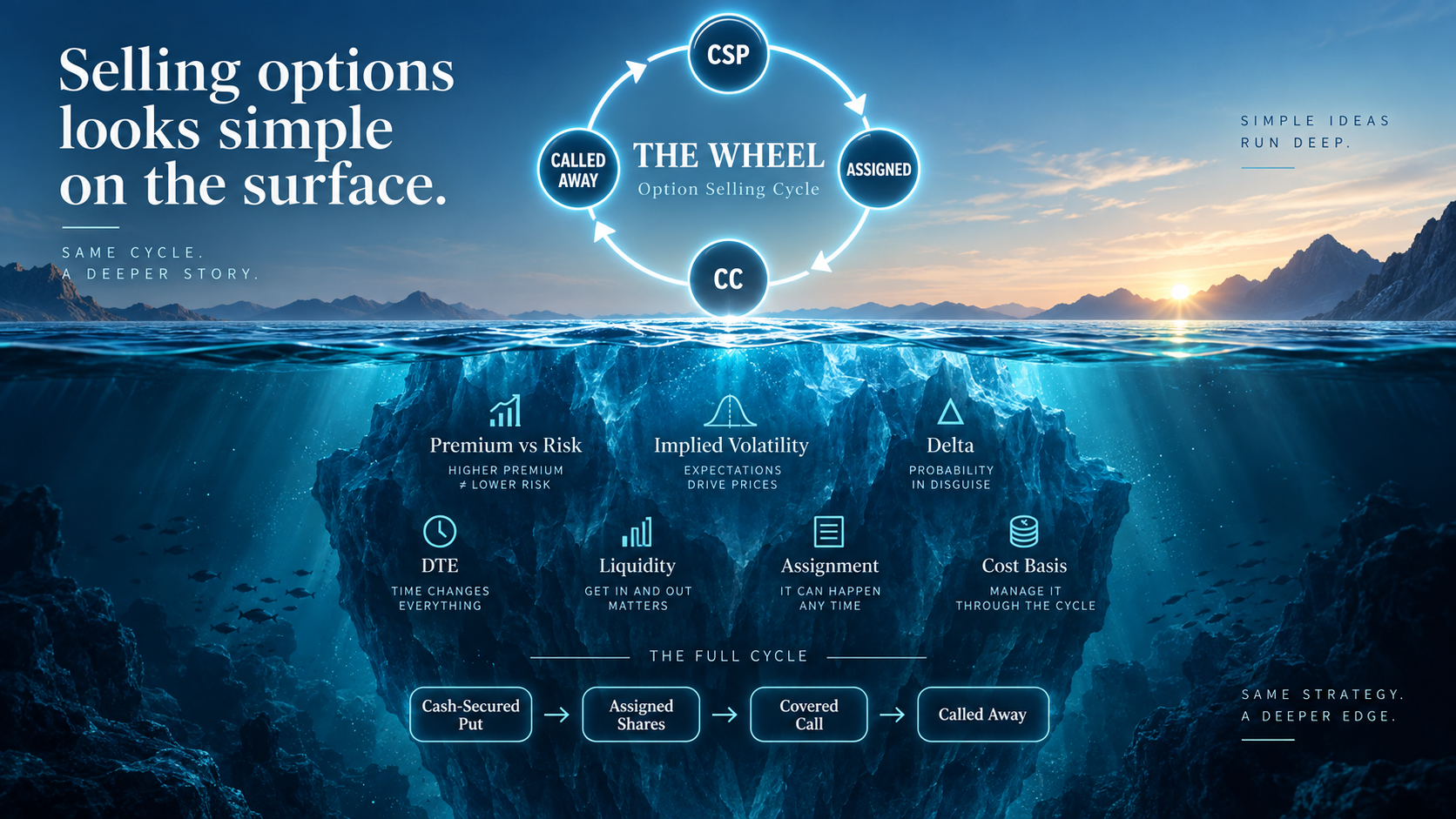
Selling options looks simple on the surface.
Find a stock. Pick a strike. Sell a put or covered call. Collect premium.
But the more time you spend actually managing positions, the more you realize that the premium itself is only a small part of the decision.
What matters is everything around it:
- What am I being paid relative to the risk?
- How volatile is the stock?
- Is implied volatility actually expensive?
- Is there an earnings event before expiration?
- How liquid is the contract?
- What happens if I get assigned?
- What is my real cost basis after several option cycles?
- Where is the broader market positioned?
- And most importantly: what am I going to do if the trade moves against me?
That is the reason I built OptionSeller.us.
It is not designed to predict the market or tell you what stock to buy next.
It is a workspace built around the way I think about selling options: understand the underlying, measure the risk, compare the premium, structure the position, and have a plan for what comes next.
One Workspace for the Options-Selling Process
Most options tools are very good at one particular job.
A screener may help find contracts.
A broker may show positions.
A charting platform may help analyze price.
A volatility platform may provide IV data.
A spreadsheet may track cost basis.
But the actual workflow of an option seller often moves between all of them.
OptionSeller.us is my attempt to bring the most useful parts of that workflow into one place.
The site currently centers around four areas:
Wheel Dashboard — screen, structure, and track option-selling positions.
Gamma Exposure — understand SPX and NDX gamma structure and important market levels.
Library — learn the concepts behind selling options from beginner through more advanced topics.
Explorer — find useful market tools, research, articles, resources, and market context.
None of these sections is intended to replace your broker or your own research.
They are meant to help organize the decision-making process.
1. The Wheel Dashboard
The Wheel Dashboard is the main working area of OptionSeller.us.
It is built around a common options workflow:
CSP → Assigned → Covered Call → Called Away → CSP
A Cash-Secured Put can potentially lead to assignment.
Assignment creates a stock position.
That stock can then be paired with a Covered Call.
If the shares are eventually called away, the cycle can start again.
The concept itself is simple.
Tracking it properly over multiple option legs is not.
The Dashboard is designed to make that process easier to see and manage.
Open Account to save your positions, track your Wheel history, and pick up where you left off.
Screen Contracts Beyond Just Premium
One of the biggest mistakes I try to avoid is sorting option contracts by premium and assuming the highest number represents the best opportunity.
Premium exists for a reason.
A contract may pay more because the underlying is volatile, the strike is closer to the stock price, liquidity is poor, an important event is approaching, or the market is pricing a genuinely large risk.
The screener therefore looks at several dimensions rather than a single yield number.
Depending on the search, you can work with metrics including:
HPY Premium relative to strike.
Delta A quick way to compare directional exposure between strikes.
Implied Volatility How much volatility the option market is currently pricing.
IV / Historical Volatility A comparison between implied and realized volatility rather than looking at IV in isolation.
DTE Days remaining until expiration.
Open Interest Useful context for contract activity and liquidity.
Bid-Ask Spread An important part of the real cost of entering and exiting a position.
IV Rank Where current IV sits relative to its own historical range.
Z / Sigma Distance
Premium relative to Sigma
Earnings filtering
The goal is not to produce a magical score.
The goal is to make it harder to accidentally look at one attractive number while ignoring the risk behind it.
Preset groups such as SAFE, BALANCED, and AGGRESSIVE can also provide starting points before the filters are adjusted for your own research process.
2. Track the Entire Wheel, Not Just the Current Contract
A broker normally shows what you own today.
For a Wheel position, that may not tell the whole story.
Imagine that you:
sell a put,
close it,
sell another put,
get assigned,
sell several covered calls,
roll one of those calls,
and eventually have the shares called away.
Looking only at the latest option contract can make it difficult to answer a surprisingly basic question:
What did this position actually cost me?
OptionSeller.us keeps the position together as a Wheel rather than treating every option leg as an unrelated trade.
The Dashboard can track stages such as:
CSP
CC
Uncovered shares
Closed positions
It also tracks the relationship between the current share price, unit cost, capital used, and open gain or loss.
The idea is to preserve the history of the position instead of losing context every time one option expires or gets closed.
Unit Cost Matters
One number I find particularly useful is Unit Cost.
Instead of looking only at the original stock purchase price, Unit Cost attempts to reflect what the shares effectively cost after completed option legs are taken into account.
That creates a clearer picture of a Wheel that has gone through multiple cycles.
It does not change the market value of the shares.
It simply provides another way to understand the economics of the entire position.
3. Covered Call Chain
Owning 100 shares creates another decision:
Which covered call should I sell, if any?
Again, the highest premium is not automatically the answer.
A closer strike may provide more premium while also increasing the possibility that the shares are called away.
A farther strike may preserve more upside but offer less premium.
The Covered Call Chain is designed to make those trade-offs easier to compare.
Contract information can include:
- Strike
- Bid and Ask
- Credit based on the bid
- DTE
- Delta as a call-away risk proxy
- HPY
- Annualized yield
- Potential result if shares are called away
- Open Interest
You can also approach the chain based on the objective of the position — for example, whether the priority is keeping the shares or being comfortable with having them called away.
The point is not to identify one universally “best” covered call.
There isn't one.
The best structure depends on what you want the stock position to accomplish.
4. Options Ideas Based on an Actual Thesis
Sometimes the starting point is not a screener.
It is an opinion.
For example:
I think this stock could be around a certain price by a certain date.
That statement already contains useful information.
You have an underlying.
You have a price thesis.
You have a timeframe.
And you may have a preference about whether you want to own the shares afterward.
The Ideas section uses those inputs to explore structures that may fit the scenario.
The objective is not to turn a market opinion into an automatic trade recommendation.
It is to help connect a thesis with the mechanics of an options structure and give you a starting point for further research.
When market data is available, contract information can be based on the live option chain; outside market hours, the latest available quote may be used.
5. Gamma Exposure: Looking at the Market Above the Individual Stock
An individual option position does not exist in isolation.
Sometimes the broader index environment matters just as much as the stock itself.
That is why OptionSeller.us has a separate Gamma Exposure section for SPX and NDX.
The page is designed to organize several pieces of market structure into one view:
Gamma regime
Important gamma levels
Intraday changes in GEX
Gamma squeeze conditions
Volatility
Gamma exposure by strike
GEX heatmaps
Volatility surface
and a deeper analysis layer for interpreting the current structure.
Modeled GEX and Its Limitations
Open interest tells us how many contracts are outstanding, but it does not reveal who is long or short each side of those positions.
Because of that, Gamma Exposure on OptionSeller.us is presented as a modeled estimate of market structure, not a direct view of dealer inventory.
The model combines option gamma, current open interest, contract multipliers, and a clearly defined positioning assumption to estimate exposure across strikes.
The goal is to highlight areas where gamma may influence market behavior and identify levels worth watching — not to claim that we can see exactly how every dealer is positioned or how they will hedge next.
6. AI Is Used for Interpretation — Not to Invent the Numbers
AI can be useful when there is already a structured dataset to interpret.
It becomes much less useful when it is asked to manufacture market numbers.
For that reason, the GEX workflow separates the two jobs.
Market calculations come from the underlying data and models.
AI is used as an interpretation layer to help explain what those numbers may imply.
For the deeper GEX analysis, the site can combine the existing snapshot with volatility-model context and recent catalysts, while keeping the numerical calculations separate from the AI interpretation.
That separation is intentional.
Calculate first. Interpret second.
7. The Options Seller Library
Tools become much more useful when you understand what the numbers mean.
That is the purpose of the Library.
The Options Seller Library is structured as a learning path rather than a collection of random definitions.
It starts with fundamentals such as:
- What options actually are
- Calls and puts
- Reading an option contract
- Intrinsic and extrinsic value
- Delta, Gamma, Theta, and Vega
- Implied Volatility
Then it moves into the practical decisions that an option seller has to make:
- Choosing an underlying
- Choosing a strike
- Selecting expiration
- Evaluating liquidity
- Comparing volatility
- Understanding event risk
- Managing positions
- Thinking about portfolio exposure
The material eventually extends into more advanced volatility and portfolio concepts.
The Main Principle Behind the Library
There is one idea that appears repeatedly throughout the site:
High premium does not automatically mean a good trade.
An option seller is being paid because someone else wants to transfer risk.
That risk may involve price movement, volatility, time, events, liquidity, assignment, or extreme market moves.
So instead of asking:
“How much premium can I collect?”
I prefer to ask:
“How much am I being paid to accept this risk?”
That small change in wording creates a very different research process.
8. Explorer: Research Beyond the Dashboard
Not everything belongs inside a trading dashboard.
Sometimes I simply want to save a useful tool, explain a concept, review something I actually use, or publish a resource that may help another investor.
That is what Explorer is for.
Explorer organizes content into areas such as:
Top Picks
Useful Tools
Special Offers
Ideas & Tips
Trading Insights
Personal Finance
Kids & Family
AI Tools
Helpful Resources
It also provides search and additional market context through News, Macro, and Feed views.
You may find detailed trading articles beside something completely unrelated to options.
That is intentional.
OptionSeller.us is primarily built around options, markets, and financial research, but Explorer is where I can share other things I find genuinely useful.
Some Explorer links may also be affiliate links that help support the cost of running the site.
9. Market Alerts Without Turning the Site Into a Headline Feed
Information is useful.
Noise is not.
The Dashboard includes configurable notifications so users can choose which types of updates matter to them.
Current alert categories include:
Pre-Market Brief Important economic events and information ahead of the U.S. market open.
Market Highlights Market-moving developments surfaced through the live status area.
Market Bells Opening and closing bell notifications.
Support Replies
Explorer News
The purpose is not to reproduce every headline appearing during the day.
It is to keep important context close to the tools being used to evaluate positions.
10. What OptionSeller.us Is — and What It Is Not
OptionSeller.us is a research, tracking, education, and analysis project.
It is built for people who want to understand the mechanics behind an options position rather than simply look for a ticker and a premium.
It can help organize information.
It can perform calculations.
It can make comparisons easier.
It can visualize market structure.
It can help track a multi-leg Wheel.
And it can provide educational context around the numbers.
But it cannot remove uncertainty from the market.
No screener knows where a stock will trade next.
No Delta guarantees the probability of assignment.
No support level guarantees that a stock will stop falling.
No amount of Theta eliminates Gamma risk.
No GEX model perfectly reveals dealer positioning.
And no AI analysis knows the future.
Those limitations are part of the design philosophy rather than something to hide.
Who Is OptionSeller.us For?
The site will probably make the most sense if you:
- Sell Cash-Secured Puts or Covered Calls
- Use the Wheel strategy
- Want to track positions across multiple option cycles
- Compare contracts using more than premium alone
- Study implied and realized volatility
- Pay attention to SPX or NDX market structure
- Want to understand why an options trade works instead of simply copying one
- Prefer having research, education, and position management closer together
You do not need to use every section.
Some people may primarily use the Library.
Others may spend most of their time in the Wheel Dashboard.
Some may only check GEX when index conditions become important.
The site is designed so those tools can coexist without requiring every user to follow exactly the same process.
Why I Continue Building It
OptionSeller.us started from a practical problem:
I wanted the information I use when evaluating option-selling positions to be easier to organize.
Over time, that expanded from screening contracts into tracking Wheels, comparing covered calls, studying volatility, looking at gamma structure, organizing market information, and documenting the concepts behind the process.
The project continues to evolve around the same question:
What information actually helps make a better-informed decision?
If a feature helps answer that question, it belongs.
If it simply adds another number to the screen without helping explain risk, it probably does not.
That principle will continue to guide how OptionSeller.us develops.
Start With the Process, Not the Premium
If there is one idea I would want someone to take away from OptionSeller.us, it is this:
Do not start with the premium. Start with the risk.
Understand the company.
Know the upcoming events.
Look at liquidity.
Understand volatility.
Choose the structure.
Know what assignment would mean.
Think about what happens if you are wrong.
Then decide whether the premium is enough.
That is the approach behind OptionSeller.us.
Research the risk. Understand the structure. Then evaluate the premium.
OptionSeller.us provides tools, models, educational material, and market information for research and analysis. Nothing on the site should be considered investment advice. Options involve risk, and users should independently evaluate any position before making financial decisions.