4 Options Trading Books Worth Reading for Serious Option Sellers
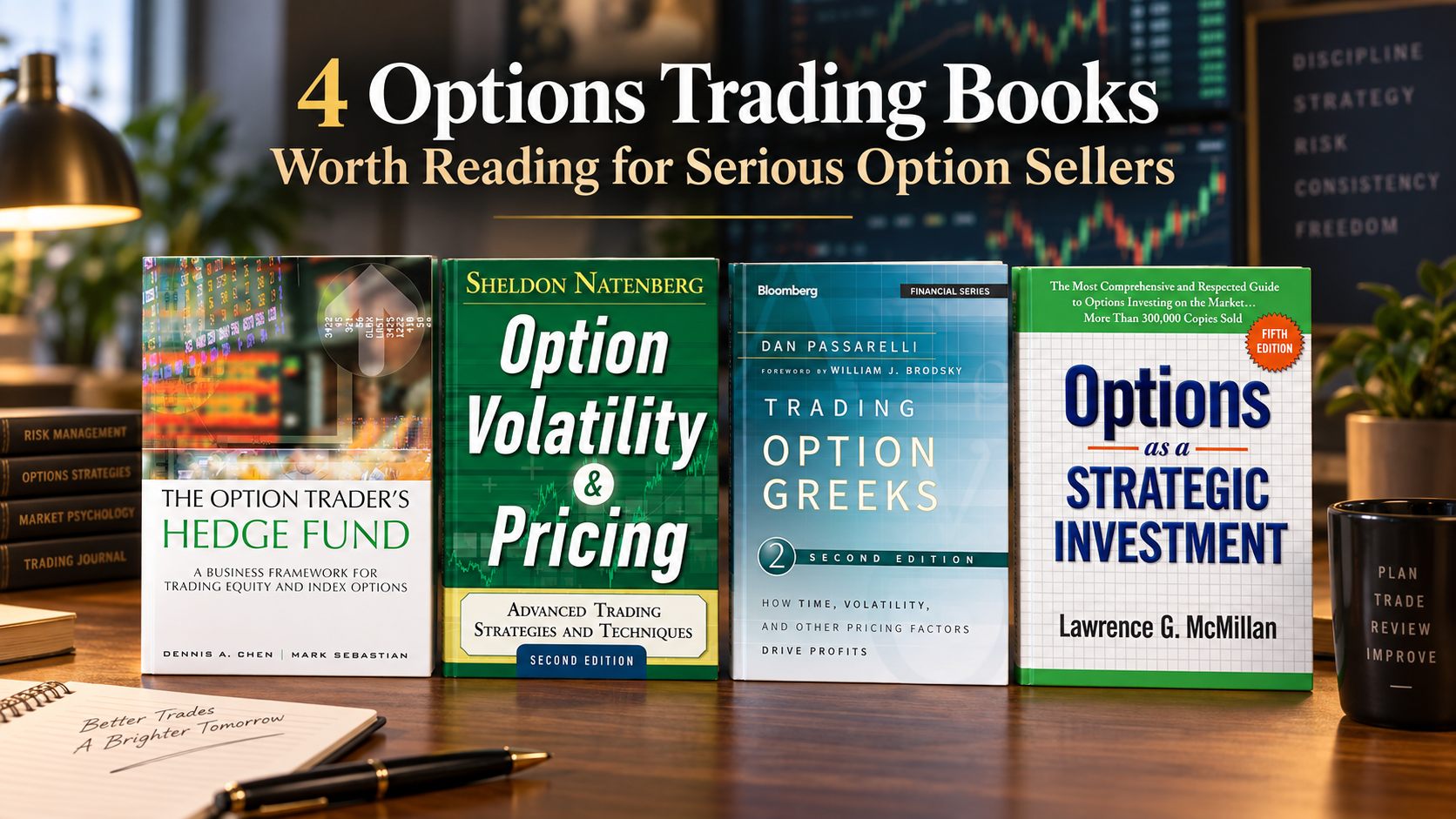
Four options trading books worth reading if you want to better understand volatility, Greeks, risk, and the mechanics behind selling premium.
There are plenty of books that explain calls, puts, covered calls, and basic option strategies.
Those are useful when you're getting started.
But once you begin selling cash-secured puts, covered calls, or other premium strategies, the questions become more important:
- Is the premium worth the risk?
- Why is implied volatility elevated?
- How will the position behave if the stock moves sharply?
- When does rolling make sense?
- How much risk am I accepting for the return I'm targeting?
For serious option sellers, understanding volatility, Greeks, position management, and risk matters much more than memorizing another twenty strategies.
These are four books I think are worth having in an options library.
1. The Option Trader's Hedge Fund
(Dennis A. Chen & Mark Sebastian)
Best for: The option-selling mindset
Optionseller Rating: 9.5/10
If your primary goal is generating income from selling options, this may be the most directly relevant book on the list.
Its central idea is simple:
Treat option selling like an insurance business.
When you sell an option, you receive premium in exchange for accepting risk.
That means the important question isn't:
“How much premium can I collect?”
It's:
“How much risk am I taking to collect that premium?”
That distinction matters.
A trade can have a high probability of profit and still carry unattractive risk.
A rich premium can also be a warning that the market expects significant uncertainty.
Good option selling therefore requires more than finding attractive yields.
You also need to think about:
- position sizing,
- volatility,
- liquidity,
- diversification,
- concentration,
- maximum loss,
- and what you'll do when a trade moves against you.
That's what makes this book particularly useful for premium sellers.
Why I Recommend It
The book encourages you to manage options as a portfolio, rather than looking at each trade in isolation.
That mindset fits especially well with:
- Cash-secured puts
- Covered calls
- The Wheel strategy
- Other premium-selling approaches
One lesson worth remembering:
Premium is compensation for accepting risk.
High premium is not free money.
If an option suddenly pays much more than usual, ask why.
Maybe implied volatility increased.
Maybe earnings are approaching.
Maybe the market expects a larger move.
Maybe something changed in the underlying company.
Your job isn't to find the highest premium.
Your job is to decide whether the premium makes sense relative to the risk.
Who Is It For?
I would recommend this book to someone who already understands the basics of:
- calls and puts,
- strike prices,
- expiration,
- assignment,
- covered calls,
- and cash-secured puts.
If you're completely new to options, learn those concepts first.
Optionseller Verdict
One of my favorite books specifically for people who sell options.
If you already collect premium and want to become more systematic about risk management, this is an excellent place to start.
→ View The Option Trader's Hedge Fund on Amazon
2. Option Volatility and Pricing
(Sheldon Natenberg)
Best for: Understanding volatility and option pricing
Optionseller Rating: 10/10
If I had to choose the most important technical book on this list, this would probably be it.
Options aren't priced only according to whether a stock might go up or down.
Their value is influenced by several variables, including:
- underlying price,
- strike price,
- time to expiration,
- interest rates,
- dividends,
- and volatility.
For option sellers, volatility is especially important.
Why Volatility Matters
Imagine two stocks are both trading at $100.
Each has a $90 put available.
One option pays $1.00.
The other pays $4.00.
At first glance, the $4.00 premium may look much better.
But the more important question is:
Why is the market willing to pay four times as much?
Usually, higher premium reflects higher expected risk.
That risk may show up through implied volatility.
This is why one of the principles I like to keep in mind is:
HIGH IV ≠ automatically SELL.
And:
LOW IV ≠ automatically BUY.
Volatility always needs context.
Why This Matters for Option Sellers
Many sellers focus heavily on:
Premium
Delta
DTE
Those are useful metrics.
But they don't tell the entire story.
Before selling a put, I also want to understand:
- Is IV elevated?
- Why is IV elevated?
- How does current volatility compare with normal conditions?
- Is earnings approaching?
- Is the market pricing a significant downside move?
- Is the premium enough for the risk?
Natenberg helps build the framework needed to think about those questions.
What You'll Learn
The book goes deeper into concepts such as:
- implied volatility,
- historical volatility,
- option pricing,
- Greeks,
- probability,
- hedging,
- volatility relationships,
- and position risk.
You don't need to memorize every formula.
The real value is learning how the different variables interact.
The Downside
This is not a light beginner read.
Some sections are technical, and some chapters may require more than one pass.
That's okay.
I would rather understand one chapter of this book properly than rush through several books that only repeat basic strategy diagrams.
Optionseller Verdict
Essential reading if you want to understand options beyond the surface level.
For option sellers especially, understanding volatility can completely change how you evaluate premium.
→ View Option Volatility and Pricing on Amazon
3. Trading Options Greeks
(Dan Passarelli)
Best for: Understanding how positions change after entry
Optionseller Rating: 9.5/10
Most options traders eventually learn the basic Greeks:
Delta — directional sensitivity
Theta — time decay
Vega — volatility sensitivity
Gamma — how quickly delta changes
Learning the definitions is useful.
But the important part is understanding how they work together.
That's where this book becomes valuable.
Why Greeks Matter for Sellers
Option sellers often hear:
“Theta is working for me.”
That's true.
But theta is only one part of the trade.
Suppose you sell a put.
As time passes, theta may help reduce the option's value.
But at the same time:
- the stock can decline,
- implied volatility can rise,
- delta can increase,
- and gamma risk can grow as expiration approaches.
Theta can be helping while the overall position is still losing money.
Understanding Greeks prevents you from thinking that collecting time decay automatically means the trade is safe.
A Practical Example
Two puts may both offer a 1% premium yield.
But one might have:
- higher delta,
- higher implied volatility,
- shorter expiration,
- and much greater gamma risk.
Same yield.
Very different risk profile.
That's why Greeks become increasingly important once you start selling options regularly.
Useful for Wheel Traders
Suppose you sell a cash-secured put and the stock falls.
Now you need to decide whether to:
- hold,
- close,
- roll down,
- roll out,
- or accept assignment.
The Greeks won't make that decision for you.
But they help you understand how the existing position behaves and how its risk is changing.
The Downside
This isn't primarily a strategy book.
It won't simply hand you dozens of payoff diagrams and tell you which trade to use.
I actually consider that a strength.
The focus is on understanding the mechanics behind your positions.
Optionseller Verdict
Excellent for traders who understand basic options and want to improve position management.
If delta, theta, gamma, and vega still feel abstract, this is the book I would read next.
→ View Trading Options Greeks on Amazon
4. Options as a Strategic Investment
(Lawrence G. McMillan)
Best for: A long-term options reference
Optionseller Rating: 9/10
This book is massive.
I wouldn't approach it like a normal book that needs to be read from beginning to end.
Instead, think of it as an options reference manual.
Use it when you want to study a particular strategy, adjustment, or position-management situation in more depth.
Why It's Useful
Options positions don't remain static.
A covered call can move deep in the money.
A cash-secured put can move against you.
A trade that originally had 45 DTE eventually reaches 10 DTE.
Volatility changes.
The stock changes.
Your thesis can change.
At that point, you need more than:
“Sell at 30 delta and wait.”
You need to understand your alternatives.
McMillan covers a broad range of option strategies and management concepts, making the book particularly useful as a reference.
Particularly Useful For
- Covered calls
- Put selling
- Rolling
- Spreads
- Adjustments
- Hedging
- More advanced option structures
Even if you primarily trade the Wheel, understanding how other structures work can help you understand what happens when you modify an existing position.
Don't Try to Learn Every Strategy
There are dozens of option structures:
Iron Condors, Butterflies, Calendars, Diagonals, Ratio Spreads, Iron Butterflies, and many more.
You don't need to master all of them.
I'd rather deeply understand:
- cash-secured puts,
- covered calls,
- volatility,
- Greeks,
- position sizing,
- and risk management.
Then add more strategies only when there's a reason.
Optionseller Verdict
An excellent long-term reference for serious options traders.
It wouldn't be my first book for a complete beginner, but it's one I would want to keep in my library.
→ View Options as a Strategic Investment on Amazon
Which Book Should You Read First?
It depends on what you need most.
If you're primarily an option seller
Start with The Option Trader's Hedge Fund.
It helps build the right mindset around premium, portfolio management, and risk.
If you want to understand options more deeply
Read Option Volatility and Pricing.
Volatility is too important for option sellers to ignore.
If Greeks still confuse you
Read Trading Options Greeks.
It will help connect the numbers in the option chain with what is happening to your position.
If you want a comprehensive reference
Get Options as a Strategic Investment.
Keep it nearby and use it when you need to research a strategy or adjustment.
My Recommended Reading Order
For someone who already understands basic calls and puts:
1. The Option Trader's Hedge Fund
Develop the right mindset around premium and risk.
2. Trading Options Greeks
Understand how positions behave after you open them.
3. Option Volatility and Pricing
Go deeper into volatility, pricing, and risk.
4. Options as a Strategic Investment
Keep it as your long-term reference.
There is no need to rush through them.
Read a chapter, apply the concept to positions you already understand, and then continue.
One Important Lesson
Selling options can produce a high percentage of winning trades.
But:
High win rate does not automatically mean low risk.
One large loss can erase many small premium gains if risk isn't controlled.
That's why I would spend more time learning:
- Volatility
- Greeks
- Position sizing
- Risk management
than searching for another indicator that claims to identify the perfect option to sell.
The objective isn't to collect the most premium.
The objective is to collect premium when the expected reward makes sense relative to the risk.
Those are very different things.
Final Thoughts
If you're serious about becoming a better option seller, these four books are enough to keep you studying for a long time.
My ranking:
1. The Option Trader's Hedge Fund Best overall mindset for premium sellers.
2. Option Volatility and Pricing Best for understanding volatility and pricing.
3. Trading Options Greeks Best for understanding how positions behave.
4. Options as a Strategic Investment Best long-term reference.
You don't need twenty options books.
You need a few good resources—and enough time to actually understand and apply what they teach.
Optionseller.us provides educational information and research tools. This content is for educational purposes only and is not investment advice.
Product availability and pricing may change over time.